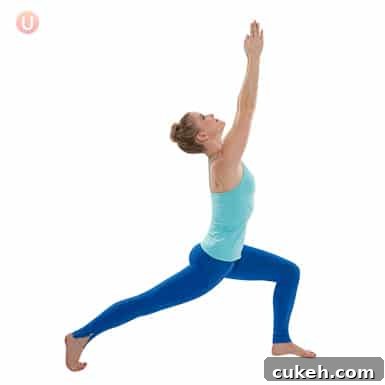
A crescent lunge is a foundational yoga posture that deeply stretches the hip flexors, groin, and legs while opening the chest and shoulders. Practicing crescent lunges also strengthens and tones the thighs, hips, and glutes, and challenges balance and stability, making it a versatile addition to any routine.
Because of its combined benefits—stretching, strengthening, and balance—lunge variations often appear repeatedly in yoga sequences. Many people come to yoga seeking relief for hip tightness or lower-back tension, and the crescent lunge addresses those concerns directly.
Stretching the hip flexors can be difficult with limited options; the crescent lunge is one of the most effective poses to target that area. It helps loosen tight hips and can ease discomfort related to prolonged sitting or sedentary habits.
Crescent Lunge Pose Instructions
Follow these steps to perform a Crescent Lunge (on the knee or with the back foot active):
- Begin standing. Step the ball of your left foot back and position your feet slightly wider than hip-width, as if on parallel tracks.
- Inhale and reach both arms overhead. Bend your right knee until it forms about a 90-degree angle, keeping the front knee stacked over the ankle.
- Draw the tailbone under and press the hips gently forward while lengthening through the back leg. Relax the shoulders and continue reaching through the fingertips. Hold for 30 seconds, then switch sides.
As you move into the posture, tuck the tailbone and press the hips forward while lifting the chest and reaching the arms back over the head. The resulting curve resembles a crescent moon—hence the name—and increases the stretch across the front of the hips, chest, and shoulders.
For the back foot you have two common options: keep the toes tucked with the ball of the foot on the ground, or point the toes and rest the top of the foot on the mat. Both variations provide an effective stretch and can be chosen based on comfort and ankle mobility.
Watch the demonstration below as Chloe Freytag shows how to perform a crescent lunge:
What Muscles Does a Crescent Lunge Work?
The crescent lunge primarily targets the hip flexors, quadriceps, hamstrings, glutes, and the muscles of the inner thigh. It also engages core muscles to maintain balance and supports spinal alignment, encouraging improved posture and stability through the torso.
Benefits of Crescent Lunges
Incorporating crescent lunges into your practice offers a range of benefits that improve mobility, strength, and overall movement quality. Key advantages include:
Stronger Legs
Holding the crescent lunge is an isometric challenge that builds strength in the thighs, hips, and glutes. Even without dynamic movement, the muscles work steadily to stabilize the body, improving endurance and functional strength.
Stretches Legs and Hips
This posture provides a deep stretch to the hip flexors, groin, and leg muscles. It can help alleviate lower back tightness and sciatica-related discomfort for some practitioners, and it serves as a preventative measure to keep the hips mobile and pain-free when practiced consistently.
Opens the Front of the Body
The pose expands the chest, shoulders, and front torso, counteracting the forward-folded positions common in daily life and desk work. This opening supports better breathing and helps relieve tension across the front body.
How Many Calories Does a Crescent Lunge Burn?
Calorie burn depends on intensity and duration. Static yoga holds like the crescent lunge burn fewer calories than vigorous cardiovascular exercise, but a well-paced yoga class that includes lunges can contribute meaningfully to overall calorie expenditure. Focus on consistency and form to maximize both mobility and metabolic benefits.
Other Exercises Similar to Crescent Lunge
If you enjoy crescent lunges, consider trying these complementary postures and movements that offer similar benefits:
Yogi Squat
Warrior I
Screaming Pigeon